

Why “Past Performance” Misleads Investors
At some point, we have all looked into a fund factsheet, and have seen the fine print: past performance does not guarantee future results. That warning is more than a formality. It is a useful reminder of how to interpret an investment’s track record.
Historical returns feel reassuring because they offer a clean, measurable story of success, but markets evolve. Cycles turn, leadership rotates, and periods of strong performance can reflect rising valuations or unusually favourable conditions that may not repeat.
What appears to be consistency may reflect a favourable environment rather than an ability to perform across different market conditions.
What History Can and Cannot Tell You
Historical data is valuable for understanding how assets behaved under different conditions, and informing long-term expectations. Where investors go wrong is using recent performance as a forecast.
-
Long-term averages hide short-term volatility. A hypothetical 7% average equity return can include periods of deep losses and outsized gains that arrive irregularly. Investors do not experience steady averages - they experience a sequence of returns.
-
Markets move through regimes. Interest rates, inflation, policy frameworks, and economic structure change over time. Strategies that benefited from falling rates or expanding valuations may face very different conditions going forward.
- Starting valuations matter. Prices and yields provide important context for future returns. When strong past returns reflect rising valuations, some anticipated future gains may already be reflected in today’s price.
Recency Bias, FOMO and Performance Chasing
Recency bias is the tendency to overweight the most recent information when making decisions. In investing, that often means buying what just went up and selling what just lagged. This encourages performance chasing,a behaviour that undermines long-term outcomes when investors assume recent gains will continue without considering valuation, risk, or portfolio fit.
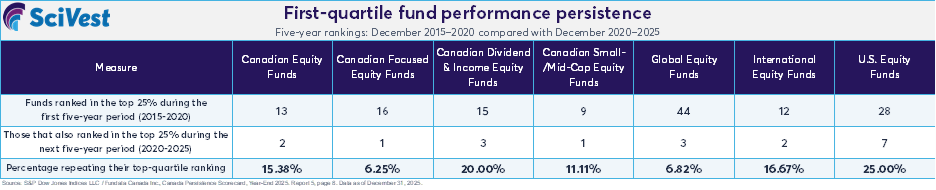
The difficulty is that yesterday’s strongest performers do not reliably remain tomorrow’s leaders. Most actively managed Canadian equity funds underperform their benchmarks over long horizons, while persistence research shows that relatively few funds maintain top rankings over successive periods. Past rankings alone are therefore an unreliable guide to future fund selection.
Fear of missing out amplifies this cycle. While recency bias concerns how investors weigh information, FOMO adds emotional urgency. Headlines, compelling narratives, and social proof can make an investment feel increasingly attractive simply because others are making money. The risk is paying a price that leaves little room for disappointment.
Trends can persist, but a recent winning streak alone is not an investment plan. For example:
-
Commodities and Canadian energy stocks performed well during parts of the 2000s and during inflationary spikes, yet they experienced long slumps as global growth and pricing power cooled.
- U.S. technology leadership dominated both the late 1990s and the 2010s, but each cycle ended with sharp reversals that caught performance chasers off guard.
To reduce the influence of recency bias and FOMO, investors can introduce structure into their decisions:
-
Predefine allocation ranges and rebalance systematically.
-
Limit new stock ideas to modest position sizes.
-
Introduce a cooling-off period before acting.
-
Anchor decisions to a written investment policy statement.
Following a trend without a plan can work until it does not. A disciplined process designed to counter recency bias is more reliable than any short-term performance chasing.
Fund Returns and Investor Returns
Fund returns are typically reported as time-weighted returns, which measure investment performance independently of investor contributions and withdrawals. Investor experience is different. Money-weighted returns account for both the timing and size of those cash flows.
The distinction matters. Buying after strong performance and selling following declines can leave investors earning less. Over time, this behaviour creates a persistent gap between fund returns and investor returns.
Research by Morningstar has consistently documented this gap, showing that investors often earn less than the funds they own, not because of fees, but because of poor timing of investment decisions. Performance chasing which contributes to this shortfall is a real-world cost of behaviour, not something listed on a statement.
The solution isn’t better forecasts. It’s a disciplined plan that reduce avoidable timing mistakes and the urge to jump in and out of markets.
Same Average, Very Different Outcomes
Sequence-of-returns risk refers to the danger that poor returns occur at an unfavourable time, particularly when withdrawals are being made. Two investors can experience the same annual returns, yet finish with very different portfolio values.
A simple illustration:
-
Portfolio A experiences weak early returns, then strong later returns while withdrawing a steady amount each year.
-
Portfolio B experiences strong early returns, then weak later returns with the same withdrawals.
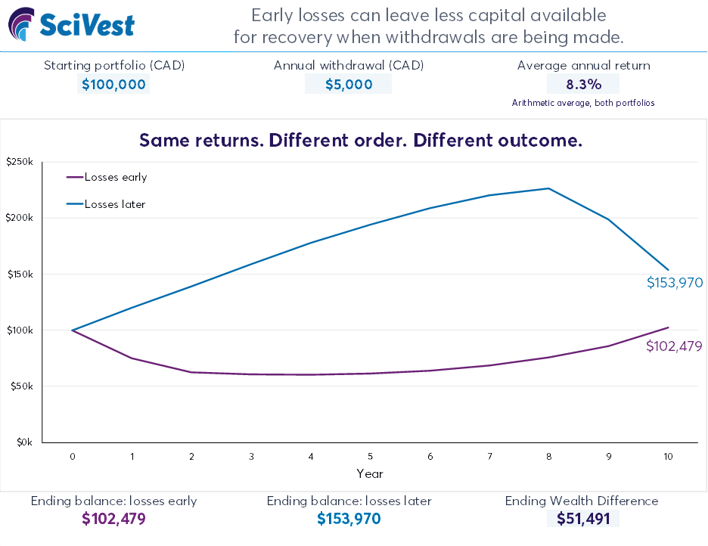
Even with identical average returns, Portfolio A is more likely to finish with less capital because withdrawals from a depressed portfolio base leave less capital available to benefit from recovery. This matters most for Canadians in the decumulation phase drawing from RRSPs, RRIFs, TFSAs, and non-registered accounts, as early losses can permanently impair portfolio sustainability.
How can we mitigate this?
-
Hold a prudent reserve of cash and high-quality bond to fund near-term withdrawals.
-
Use flexible spending rules that allow withdrawals to adjust when conditions deteriorate.
-
Rebalance systematically to manage risk, harvest gains and replenish defensive assets.
-
Consider guaranteed income tools where suitable and cost-effective.
Valuation, Costs, and Discipline Drive Results
If history is an unreliable guide and behaviour is a persistent drag, long-term outcomes depend far more on what investors can control.
Valuation as a Long-Run Anchor
Starting valuations influence forward returns. At the broad-market level, higher equity valuations have generally been associated with lower subsequent long-term returns than the same market bought at more attractive valuations. No signal is perfect, but valuation is one of the few tools with useful long-horizon power.
Put simply, the price paid matters. Strong past returns often coincide with elevated valuations, which can reduce future return potential rather than enhance it.
Costs Are Certain, Returns Are Not
Fees, taxes, and trading costs reduce what investors keep, and their cumulative effect can materially affect wealth over time as these costs compound over time. Morningstar’s research has repeatedly found that lower-cost funds have higher odds of future success compared with higher-cost peers.
In Canada, mutual fund management expense ratios have been coming down, yet they still vary widely. Paying attention to cost and tax efficiency is not a guarantee of outperformance, but managing these expenses is a practical advantage investors can control.
Discipline Beats Prediction
Discipline is not about forecasting markets correctly. It means having a rules-based process through different environments. Not rigidity but being prepared for a range of outcomes rather than relying on a single expectation.
-
Build a Globally Diversified Core: Combining Canadian, U.S., and international equities reduces geographic concentration risk, while high-quality bonds can provide diversification and liquidity aligned with cash-flow needs.
-
Rebalance Systematically: Rebalancing is one of the simplest ways to counter behavioural bias. Whether done on a calendar basis or through predefined tolerance bands, the objective is the same: trim relative winners and add to relative laggards to restore the intended asset mix and prevent unintended changes in risk.
-
Automate Contributions and Deploy Cash Intentionally: Use pre-authorized contributions for RRSP, TFSA, and other accounts. Regular contributions support consistency and DCA as well as reduce the temptation to time each purchase.
-
Write It Down and Review Annually: Maintain an investment policy statement that defines goals, risk tolerance, asset mix and rebalancing rules. Review it annually or after meaningful life changes, rather than after every market headline.
Conclusion
Historical returns tell a compelling story but they are a record of the past, not a roadmap for the future. Markets evolve, leadership changes , and the conditions that produced yesterday’s winners rarely persist.
What ultimately drives long-term outcomes is not the ability to identify what performed best, but managing what investors can control: valuation awareness, costs, diversification, and discipline. Markets will continue to cycle, trends will come and go, and volatility will arrive without warning. A resilient investment approach accepts that uncertainty and is designed to withstand it.